
In a city known for humidity, concrete, and sprawl, some of Houston’s most compelling architecture takes a softer approach—structures that don’t shout for attention but rather coolly recede into their surroundings, offering shade, serenity, and space for nature to breathe.
These buildings, often wrapped in white lattices or lifted under elegant canopies, embody an architectural ethos that’s deeply respectful of Houston’s climate and culture. They are quietly iconic—modernist in sensibility, yet generous to the public realm, they create places where people can gather, rest, and reflect.
Jump to details:
Nancy and Rich Kinder Building – Best Modern Museum Architecture in Houston
Main Building, The Menil Collection – Top Minimalist Architecture in Houston
The Ismaili Center Houston – Best New Cultural Landmark in Houston
Houston Endowment Building – Best Sustainable Civic Architecture in Houston
Raymond and Susan Brochstein Pavilion – Best University Architecture in Houston
James Turrell’s Twilight Epiphany Skyspace – Most Unique Outdoor Art Installation in Houston
Let’s explore four spaces where this philosophy shines:
Nancy and Rich Kinder Building at the Museum of Fine Arts Houston
Best Modern Museum Architecture in Houston

Opened: 2020
Architect: Steven Holl Architects
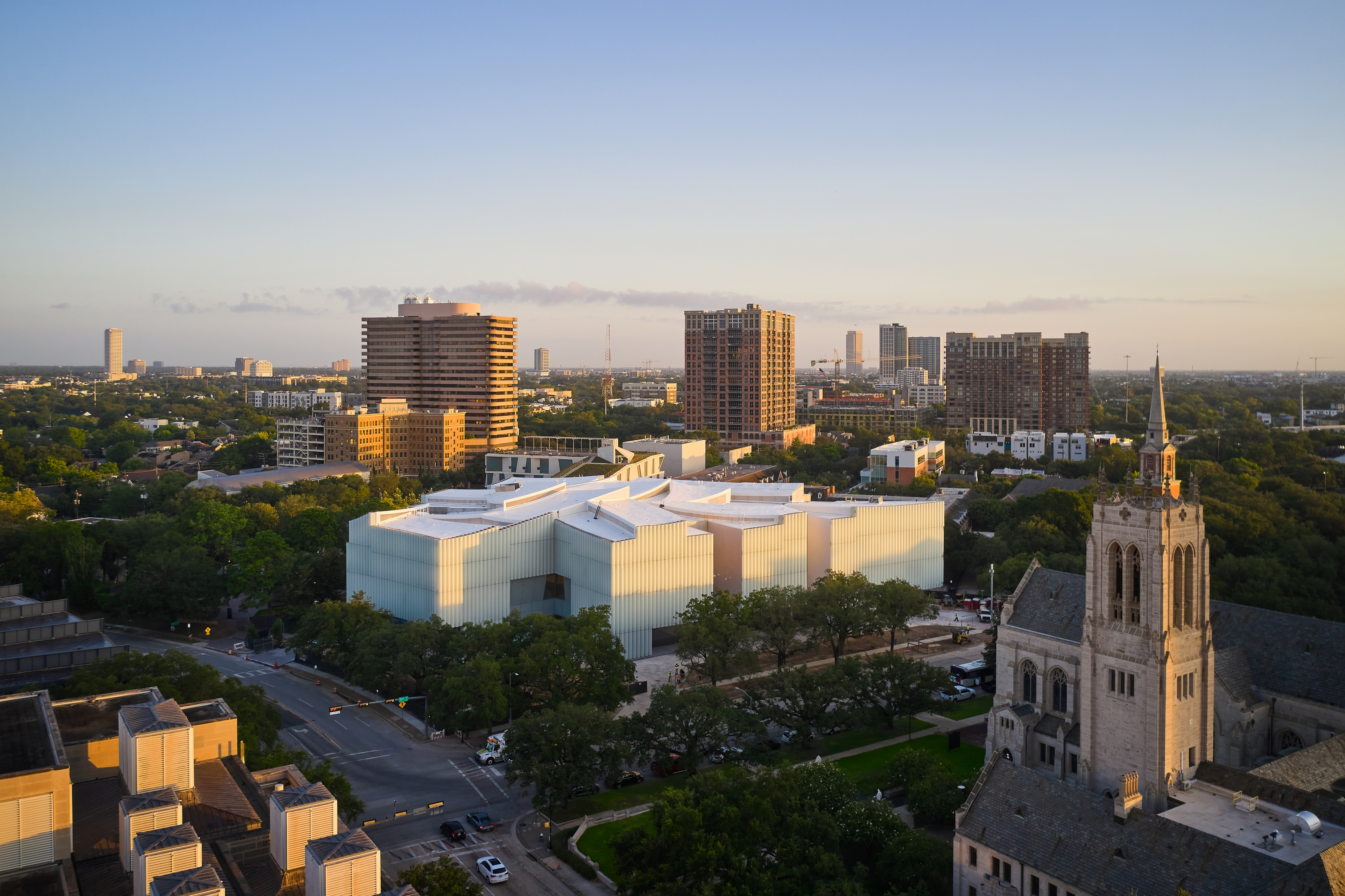
Steven Holl’s design for the Kinder Building uses translucent glass panels and a rippling, barrel-vaulted roofline to catch and diffuse light throughout the day. It’s a sculptural structure that doesn’t overshadow the park-like campus around it—instead, it glows softly at night and invites you in during the heat of the day, offering a seamless transition between art and nature.
Nearby: The Kinder Building is part of the multiblock MFAH campus—free on Thursdays! Check out the underground tunnels connecting the buildings, full of immersive optical illusions. The nearby Glassell School of Art has a rooftop terrace with one of the best city views around. You’re also steps from Hermann Park, the Houston Zoo, and Rice University’s shaded trails and art installations.
Main Building, The Menil Center
Top Minimalist Architecture in Houston

Opened: 1987
Architect: Renzo Piano
Designed by Renzo Piano, the Menil’s main building practically whispers into the landscape. A low-slung, white form with floating canopies, it creates a soft rhythm of light and shadow that mirrors the oaks overhead. The entire Menil campus is a masterclass in restraint—modernism with soul, where architecture yields to experience.
Nearby: The Menil Lawn is a beloved picnic spot for Houston’s creative class. Don’t miss the nearby Rothko Chapel for a meditative pause, and the Dan Flavin light installation in Richmond Hall. The recently opened Hotel Saint Augustine offers a moody cocktail bar and music-driven listening sessions—an ideal Montrose evening pairing.
The Ismaili Center
Best New Cultural Landmark in Houston

Farshid Moussavi’s design, still under construction, already signals timelessness. Its mashrabiya-inspired façade, reflecting pools, and garden terraces are meant to invite reflection and dialogue, while offering natural cooling and dappled light. It’s a sanctuary of geometry and grace, in tune with the flow of the bayou nearby.
Nearby: The Ismaili Center will be open to the public, though hours and access details are still forthcoming. It sits adjacent to Buffalo Bayou Park, which offers miles of hike-and-bike trails and some of the best skyline views in Houston.
Houston Endowment Building
Best Sustainable Civic Architecture in Houston

With its delicate steel columns, sun-filtering canopy, and soft color palette, the Houston Endowment building by Kevin Daly Architects and PRODUCTORA is a structure built not for display but for purpose. It feels lifted by light, surrounded by gardens, and deeply attuned to Houston’s climate and civic future.
Nearby: While the Endowment building itself isn’t open to the public, it’s right next to Spotts Park, one of Houston’s hidden gems—great for hill training, volleyball, and people-watching. Grab picnic supplies from the nearby Buffalo Heights H-E-B and enjoy sunset on the lawn.
Raymond and Susan Brochstein Pavilion at Rice Univeristy
Best University Architecture in Houston

Designed by Thomas Phifer and Partners, the Brochstein Pavilion is a lesson in elegance and lightness. Its glass walls and white trellis roof dissolve into the surrounding grove of live oaks, offering shelter without enclosure. Shaded by a louvered canopy and surrounded by lawns, the pavilion is more than a coffee stop—it’s a place to gather and nourish.
The structure never tries to upstage neither the university’s original architecture nor the trees. Instead, it listens. The materials—glass, steel, travertine—are used sparingly but with care, so the architecture evaporates into the dappled light that defines this part of the Rice campus.
Nearby: The entire central quadrangle of Rice is a gem to stroll. Pick up a coffee or pastry from the pavilion and relax under the trees, or use it as a serene base for a campus art walk.
James Turrell’s Twilight Epiphany Skyspace
Most Unique Outdoor Art Installation in Houston

Just steps from Brochstein, the Twilight Epiphany Skyspace by James Turrell is one of Houston’s most ethereal experiences. By day, it looks like a minimalist pavilion—a crisp, geometric canopy rising from the lawn. But at sunrise and sunset, it transforms. LED lights bathe the ceiling in shifting color as the open oculus frames the sky, turning a natural phenomenon into a choreographed event.
Free to the public and best experienced during a light sequence, it’s an architectural time machine that invites stillness and perspective—two things we rarely make time for in urban life.
Pro tip: Arrive early for sunset sessions and lay back on the steps for the full effect. Reservations are free and available through Rice’s website. Even outside showtimes, it’s a beautiful place to reflect.
Creating a Greener Houston Through Architecture
These buildings are more than just places—they’re gestures. Each one is deeply rooted in a green space that challenges Houston’s reputation as car-centric and concrete-heavy. They’re part of a counter-narrative, one that sees architecture not as spectacle, but as stewardship.
And yet, they remain disconnected.
The Houston Endowment and the Ismaili Center are already linked by the green thread of Buffalo Bayou Park. The Kinder Building, just a few miles away, anchors the Museum District alongside Hermann Park and Rice’s oak-lined campus. The Menil Collection, nestled in Montrose, is a world unto itself. These are nodes on a potential network—a green corridor system that could physically and symbolically unite our city’s cultural soul.
We had a chance to stitch some of these spaces together through the redesign of Montrose Boulevard. But instead, John Whitmire’s administration stripped it away—a missed opportunity to create safe, human-scaled connections between the places that define Houston’s public life.
Still, we look forward. Because the story of Houston is still being written. Let’s keep designing it around light, shade, and shared space.

Donate for a More Walkable Houston
Your donation supports a community-driven vision for a more connected, walkable, and resilient Houston. With your help, we advocate for safe pedestrian infrastructure, preserve and expand green spaces, and strengthen the bonds between neighborhoods. Every contribution helps us push forward long-term projects that make Houston healthier, more vibrant, and accessible for everyone.


Leave a Reply