
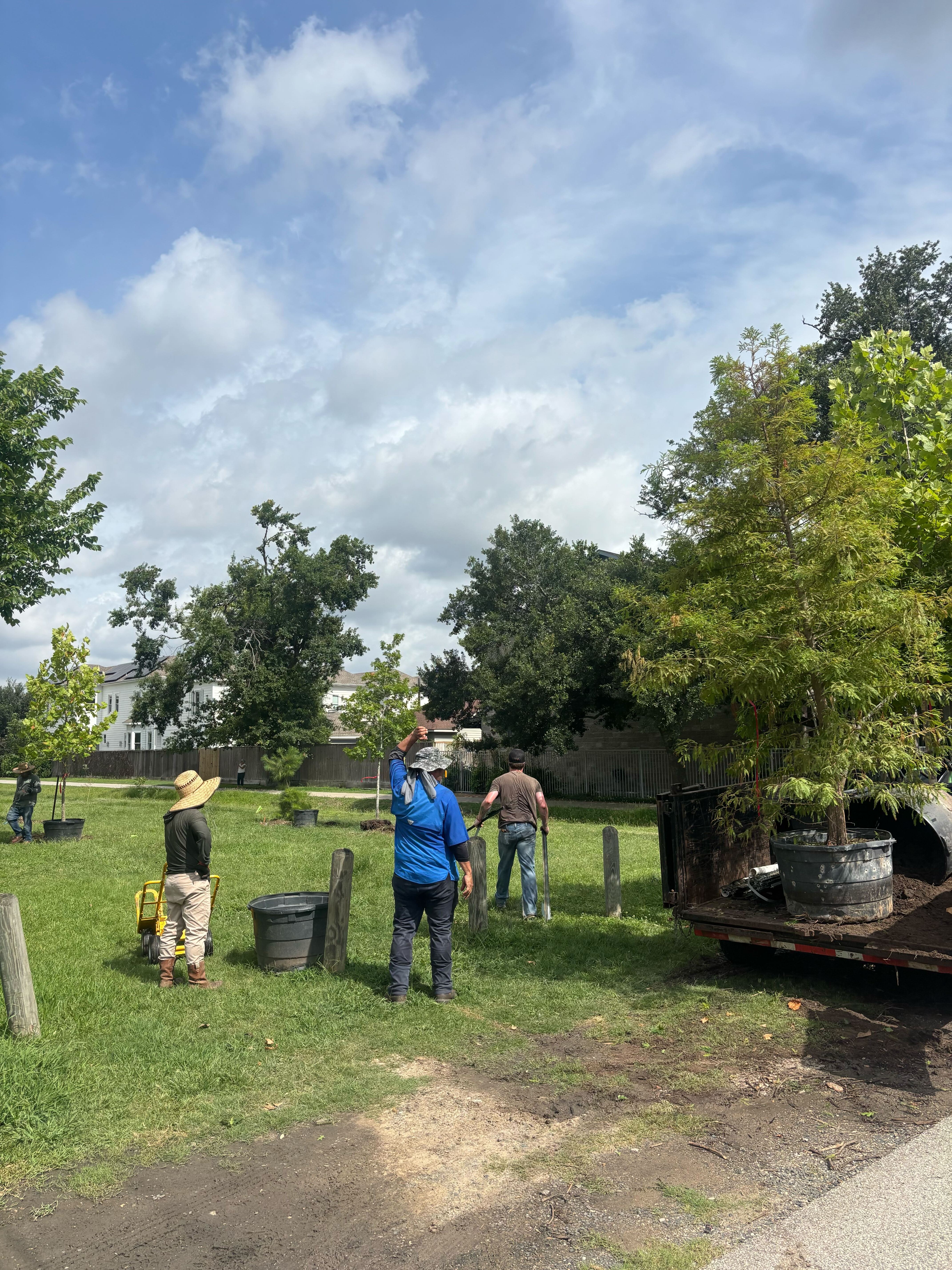
Shade 2025 is a Houston-based community campaign that planted over 200 native trees along the Heights Hike and Bike Trail. Learn how it started, how it’s growing, and how you can help. Volunteer to help water the saplings here.
How Shade 2025 Began: A Jeep Full of Trees
It started on a whim. In the summer of 2022, I heard about a free tree giveaway from Trees for Houston, and without thinking much, I asked a friend who had a Jeep and drove across town. I had no plan—just the vague idea that the trail outside my house was blisteringly hot and could use some shade. Maybe I’d pick up a few trees. Something small.
When we got there, the volunteers were ecstatic that someone had shown up with a vehicle that could haul more than a couple of saplings. “Take as many as you want,” they said. Before I knew it, I was driving back through the city with 15 sweetgum trees crammed into every corner of that Jeep, branches tickling our face, pots stacked on seats, dirt all over the floorboards. It was comical. It was beautiful.
But as soon as I got home, the reality set in: I had no permission to plant them, no irrigation plan, and no real idea how to keep them alive until I figured it all out. So, I did the only thing I could: I made space for them on my tiny alleyway. For months.
Surviving Houston’s Climate: Protecting Young Trees
As the weather turned, I scrambled to protect the trees. I moved them into the garage during freezes, wrapped them in plastic sheeting, and lined them up beneath a shop light like patients in a leafy ICU. They lost leaves and gained new ones. Some grew tall. A few looked like they might not make it.

Friends would come over and ask, “What’s the plan with these trees?” I’d smile and shrug. Because the truth was: I didn’t know. But I also knew I couldn’t give them away. I had fallen in love with what they represented: hope, patience, and a second chance at building something long-lasting in a part of the city that had been overlooked for far too long.
I treated them like members of the family. I named one. I checked on them every day. Watering became part of my routine. I’d go out with a hose or a bucket, stare at the roots, run my fingers through the soil. I asked myself questions I never thought I’d care about: Were they getting enough sun? Was the pot too small? Should I prune?
Eventually, I started drawing up planting maps. I made a spreadsheet. I talked to city departments. I met folks that knew more about tree planting. I made it my personal mission to get these trees in the ground.

Community Tree Planting Day in the Heights
The big day came in March 2023. Together with Pablo, co-founder of Livelihood, we coordinated with about a dozen volunteers and lined up a 200-ft segment along the Heights Hike and Bike Trail. We had shovels, gloves, tree guides, and wheelbarrows full of mulch. I had barely slept the night before. I kept checking my notes, double-checking tree spacing and neighbor agreements. We had everything ready.
That morning was crisp. A couple of kids came with their parents. Neighbors came with coffee and music. We planted the first tree at 8:30 AM. By 10:30, we were done down the half a block segment. I remember watching a volunteer, someone I had never met before, gently pat the soil around a tree and smile. That’s when I got the call. My grandmother had passed away.
I stood there, hands muddy, heart heavy. She had been sick for a while, and I knew this day might come. Still, I didn’t expect it to hit me right there, while planting something so full of life.
I took a quiet moment, looked down the trail, and thought: What a great honor to think that this grove could be the start of her long-lasting memory. So I kept going. We all did. We finished the planting, drove the stakes into the ground. We covered every root ball with mulch and watered them in. That day, we gave the trail 26 new trees. And I gave her a tribute in the soil.
Tree Watering, Volunteer Support, and Neighborhood Growth
What followed was a year of watering. And when I say watering, I mean hose-dragging, bucket-hauling, sidewalk-flooding, mosquito-battling labor. I thought the hard part was over. Turns out, tree survival requires constant vigilance.
But I wasn’t alone. Neighbors, family and friends offered help. A few lent their outdoor faucets. We rigged up hoses across the street and bought extra long hoses throughout the many months. While I was out on vacation, dear friends showed up and showed out to water while I was gone. Some days I’d water five trees before breakfast. Other days I’d be out at dusk, dodging bikes as I carried 5-gallon buckets down the trail.
Every tree had a story. One of the lone ones planted on the west side of the trail (most of them are planted on the east side) was nothing more than a 1.5-ft twig when it went into the ground. I had laughed when Pablo said it was still alive and I helped plant it in disbelief and skepticism. Now, it is one of the tallest ones and it even has a couple of ornaments placed on its branch by someone in the neighborhood.
And slowly, they grew.
It was around this time that I realized something else: we could do more. This wasn’t a side project anymore, it was a model. If a dozen and a half trees could change how a block felt, what could 200 do for a whole corridor of the Heights Hike and Bike Trail?
That’s how the idea for Shade 2025 was born. Well initiatilly I wanted it to be Shade 2024 as shown in this promo video. A campaign to plant 200 native trees along the Heights Hike and Bike Trail by the end of 2025. Not just small trees, well-sourced, native species, planted in the right places, with long-term watering plans and neighborhood buy-in.
Honoring Loved Ones Through Urban Forestry
I decided to dedicate the full 200-tree vision to my dad. He passed away just months before this project took off, but he taught me how to care for the world around me, to fix things with your hands and invest time in the slow, quiet work of building something lasting. The idea of leaving behind a green corridor felt like a tribute he would have understood.
On my birthday, I launched a fundraiser. I shared the story on social media with a simple goal: cover the cost of watering 200 trees over their critical first two years. I expected some donations from close friends and family. Instead, I was overwhelmed. People gave. People shared. People sent notes of encouragement. The love spread outward—from relatives to neighbors to total strangers. Within weeks, we had raised thousands of dollars.
Then came the partnerships. Silvestri Investments signed on. H-E-B chipped in. And then came another game-changer: a grant from the Houston Department of Neighborhoods, which gave us the final lift to take the project to a new level.
We used part of the funding to clear out thousands of square feet of overgrown weeds and invasive plants. Crews and heavy machinery helped flatten the soil, prepare the ground, and lay down fresh sod along large portions of the trail. What had once been an unruly patch of earth is beginning to look like a cared-for corridor—a place people could take pride in.
From 15 Trees to a 200-Tree Campaign


We broke the project into phases. The first was still grassroots—neighbors helping neighbors and trees donated by Livelihood. The second brought in small business sponsors and nonprofit partners. We added professional crews and more strategic planning for the final third phase.
The final planting wave came in June 2025. It was the hottest time of year, but we were prepared. We brought in 20 large-caliber statement trees, with several of them as big as 65 gallons. They came with fertilizer, mulch, irrigation pipe, and stakes. These were not just trees, they were landmarks. Planted in high-visibility areas, often next to neighbors who had offered access to water, they were symbols of how far we’d come.
After this third planting day, with such large beautiful trees, this project is now hard to be unnoticed. There is something deeper happening than just tree planting. It’s a network forming, right there on the trail.
Altogether, Shade 2025 planted 200 native trees along one of Houston’s most beloved trails, a handful of them will not make it, but that’s to be expected. This project plants a new story: about what’s possible when people decide that shade and beauty and care are worth the effort.
It started with a Jeep full of free trees. It ended with a forest planted by a community. And it’s only the beginning.
What’s Next: Tree Care, Community Gardens, and Wild Spaces
With the plantings complete, we’re turning our attention to stewardship and sustainability. We’re now working with the Rotary Club Skyline District to build out a forestry management system, including a full tree inventory and ongoing health monitoring.
At the same time, we’re taking a nearby wild prairie space, once just a patch of weeds and discarded trash… and beginning to shape it into a usable nature space. Not a manicured park, but a wild place where kids can explore, butterflies can thrive, and community members can reconnect with nature. We’re also laying the groundwork for a community garden project called the Railroad Garden, to activate a former utility corridor with native plants, pollinator beds, and seasonal harvests.
One of our biggest ambitions now is to help expand the City of Houston’s Adopt-an-Esplanade program to include not just streets and medians, but shared-use trails. We hope to partner with groups such as Houston Shade Brigade to streamline these policy initiatives. These aren’t car corridors. They’re people corridors. And they deserve just as much love, care, and investment.
This is the future we’re building, together, one root at a time.


Leave a Reply